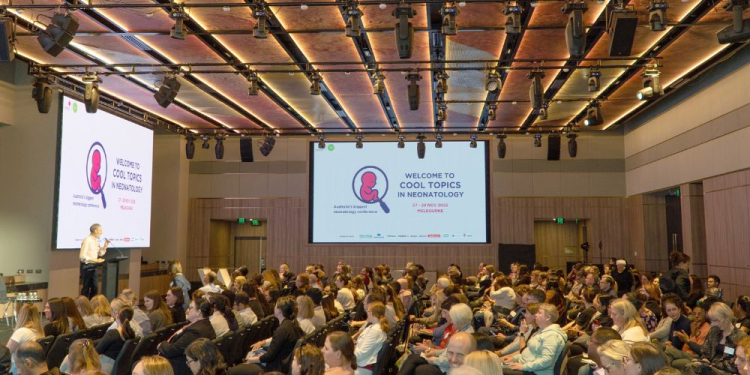
Australia’s leading neonatal conference returned to Melbourne last week, proudly hosted by the Royal Women’s Hospital. This year, Cool Topics shifted the spotlight from technology to humanity. Panel discussions explored how science and compassion can work together for better outcomes in the neonatal intensive care unit (NICU).
Families at the heart
Two parents, Jess and Dan, each shared their own stories at the conference, gripping the room. Jess described the shock of seeing her newborn intubated and covered in wires after a traumatic birth.
“I thought he was dead,” Jess said. For 102 days across three hospitals, Jess and her husband lived in a haze of alarms, medical jargon and long commutes. “The stress and exhaustion took its toll, but the love and hope kept us afloat.”
Dan’s journey was equally raw. His son Avery was born at 25 weeks, weighing just 899 grams. “Leaving him every night was something you’re never prepared for,” he said.
Juggling work, caring for a toddler, and supporting his wife felt overwhelming. Then, peer support changed everything. “Once fathers shared their stories, the shoulders dropped. We could finally talk.”

Both parents asked for practical changes. They advocated for mental health support during and after admission. They also want extended paid parental leave for families with critically ill babies. “No one should have to choose between income and being at their baby’s bedside,” Dan said.
How babies experience NICU
Dr Nat Duffy is a neonatologist at the Mercy Hospital for Women who presented her research at Cool Topics. It is anchored by a deceptively simple, yet rarely studied, question: What is the NICU experience like for babies?
Her PhD study used a novel “360-degree phenomenology” approach. She spent over 150 hours observing infants and collecting insights from parents and staff to better understand the complexity of their hospital journeys. Babies faced sensory overload from bright lights, constant noise, and frequent procedures. Yet, they thrived during moments of connection. When caregivers noticed cues and used calm voices, gentle touch, and eye contact, babies thrived.
“Every interaction shapes the baby’s emerging sense of self,” Dr Duffy explained. By allowing infant behaviour to guide our care, we nurture connection and honour the significance of every experience.
Science behind the first breaths
Alongside these human stories, leading international neonatologists shared advances in delivery-room care:
- Professor Anup Katheria, the Director of the Neonatal Research Institute at Sharp Mary Birch Hospital for Women & Newborns in San Diego, discussed the benefits of intact cord resuscitation. This method keeps the baby attached to the placenta for one to two minutes, aiding a smoother transition. Longer delays add little benefit and may increase risks like hypothermia. His team is testing if a short burst of higher oxygen can help babies avoid low oxygen levels, called hypoxia, while the cord is still intact. They want to see if this method has any side effects.
- Professor Ju-Lee Oei is a neonatologist and Chair of Neonatology at Mater Research and the University of Queensland. In her presentation, she focused on oxygen strategies. Babies who fail to reach safe oxygen levels by five minutes face higher risks of death or disability. Starting extremely preterm infants on higher oxygen and then lowering it quickly helps more babies reach the target. This approach doesn’t harm long-term outcomes.
- Professor Neena Modi, a Neonatal Medicine expert and Vice-Dean (International) at Imperial College London, called for better research. She suggested using registry data to quicken trials, connecting records for long-term follow-up, and including parents as partners. “We need globally relevant evidence, not postcode lotteries,” she said.
Other keynote speakers were Professor Richard J. Martin, the Drusinsky/Fanaroff Chair in Neonatology at Case Western Reserve University, and Professor Tobias Strunk, a leading investigator in Western Australia. They shared findings from the COSI-2 trial, which focused on reducing late-onset sepsis in extremely preterm infants.
Why it matters
Every year, more than 48,000 Australian babies are born prematurely or critically ill. Technology saves lives, but connection shapes futures. As Jess put it: “When you take those small moments to talk to a baby or check in on a parent, you’re not just providing comfort. You’re changing a life.”
Cool Topics was launched by the Women’s Newborn Research Centre in 2003.
Read related content from the Women's
-
 Cool Topics 2024: Conference discusses strategies to improve care for our youngest and sickest patients
Researchers from the Royal Women’s Hospital joined leading international experts to share the latest in newborn medicine at the annual Cool Topics conference last week.
Learn more -
.png) Cool Topics 2023 shines a light on neonatal research progress
Cool Topics 2023 shines a light on neonatal research progressBabies born prematurely need special care. To encourage ongoing learning and share the latest in newborn medical research, we host the Cool Topics in Neonatology Conference every year.
Learn more