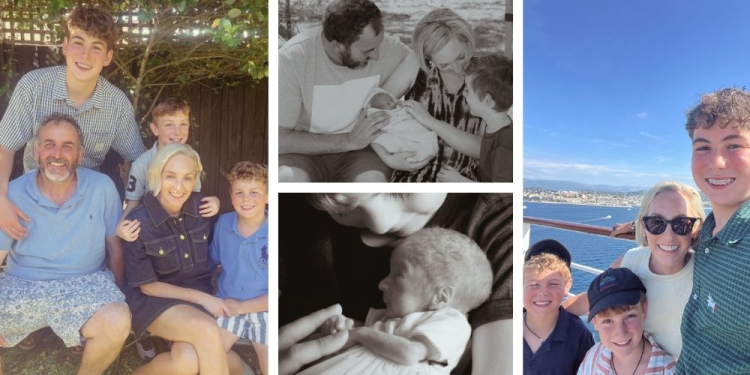
What started as mild swelling and a headache escalated into a life-threatening case of preeclampsia within hours, leaving Katie critically unwell and her baby born by emergency caesarean. Four years later, the same condition would take her daughter Ivy’s life. Now, Katie is sharing her story to raise awareness of how quickly preeclampsia can develop – and how earlier detection is helping save lives.
At nearly 36 weeks pregnant, Katie James was celebrating her baby shower when she noticed her feet were swollen. It did not seem unusual.
“I felt good,” she said. “It was just that I had to find different shoes because my feet were a bit swollen.”
The next day, a headache set in. By the afternoon, she decided to see her obstetrician. Within two hours, she was in hospital and her son Lennox had been delivered by emergency caesarean under general anaesthetic.
“My blood pressure had gone through the roof. My liver and kidneys had stopped functioning properly,” she said. “Within about two hours, Lennox had been delivered.”
Katie was critically unwell and spent days in intensive care. At the time, she did not fully grasp how serious it was.
“You think swollen feet and a headache are just part of being pregnant,” she said. “But it can come on very, very quickly.”
Four years later, during her second pregnancy, Katie recognised the warning signs. At 28 weeks, she developed another severe headache and sought care immediately. Even so, her condition deteriorated rapidly.
“I started to feel progressively worse,” she said. “The headache was very, very intense.”
Her daughter Ivy was delivered early at the Royal Women’s Hospital after an emergency transfer at 28 weeks and five days.
At first, there was hope. Ivy was breathing on her own. But the preeclampsia had caused a rupture of the placenta, leading to a severe brain bleed.
Ivy died six days after she was born.
“It was incredibly devastating,” Katie said. “But the care that we got at the Women’s was incredible. They gave us so much support and time to make very special memories with Ivy.”
A condition that can turn rapidly
Preeclampsia can strike without warning and progress rapidly. It affects around 5 per cent of pregnancies and is marked by high blood pressure and organ damage, most commonly involving the liver and kidneys.
“I think people believe it’s a slow-moving condition that just needs monitoring,” Katie said. “But it’s not just dangerous, it’s deadly.
“I almost died. Ivy died because of it. It can happen really quickly.”
Care, support and a path forward
After Ivy’s death, Katie and her husband Stewart were unsure if they could risk another pregnancy.
“The honest answer is, without the PERT testing, we would not have tried again,” Katie said.
At the Royal Women’s Hospital, the Preeclampsia Ratio Test (PERT test), developed through research led by Professor Shaun Brennecke AO, is helping clinicians detect and respond to preeclampsia earlier.
When Katie became pregnant again, her care was closely managed. She was prescribed low-dose aspirin and monitored throughout, with the reassurance that if preeclampsia developed, it could be identified earlier.
“The test didn’t remove all the fear. Nothing could,” she said. “But it gave us information, and that gave us a pathway.”
Her next pregnancy was closely managed, and she did not develop preeclampsia. Nor did she in her fourth pregnancy.
Katie is now a mother to three boys.
“We wouldn’t have them without the care and research at the Women’s,” she said.
For Katie, sharing her story is about helping others recognise the warning signs and understand how serious preeclampsia can be.
“You can feel fine one day, and within hours be critically unwell,” she said. “That’s why awareness matters.”
For families like Katie’s, research and earlier detection are making a critical difference, helping clinicians act quickly when every hour counts.