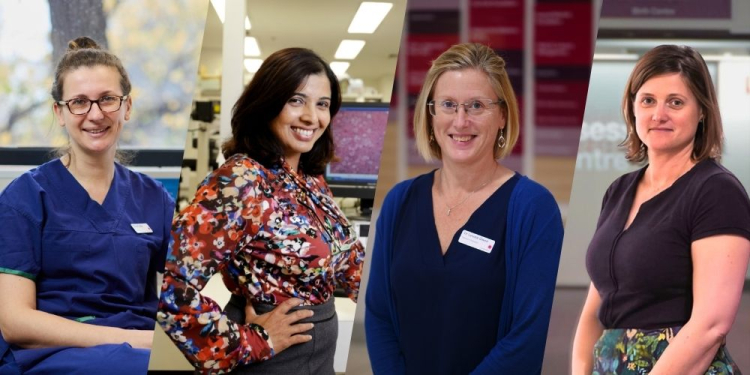
Not all scientists begin their careers imagining themselves in the research field. At the Royal Women’s Hospital, many of our most impactful researchers started somewhere else entirely… on the ward, in clinics, listening to patients describe symptoms that didn’t yet have answers. Their explorative science grew from those moments of responsibility, curiosity and the urge to make care better.
This International Day of Women and Girls in Science, we’re celebrating four clinicians whose research careers were forged in the realities of clinical life – and whose work is opening doors for the next generation.
“There’s so much we don’t understand – and patients feel it.” – Dr Charlotte Reddington, Gynaecology
Charlotte’s research began with a contradiction she saw every day. “Some people have terrible pain and no endometriosis, and others have extensive disease and never feel a thing,” she explains. “That tells us there’s a lot we don’t know.”
But what troubled her most was how women felt when invasive surgery offered no explanation. “Thirty percent of patients we take to laparoscopy don’t have endometriosis – but they have terrible pain. And they feel unvalidated.”
Her clinical frustration became a research question. She now leads a study aiming to predict endometriosis using non-invasive methods. She hopes this work will spare patients unnecessary surgery and help bring clarity to their pain. “This is what our patients need,” she says. “Pain deserves answers.”
“Women thrive when care feels continuous – that’s what sparked my research.” –Dr Robyn Matthews, Midwifery
Robyn is a midwife and never pictured herself in research. That changed when she attended workshop conducted by the Australian College of Midwives and learned about Group Pregnancy Care – a model where women move through pregnancy together, supported by the same midwives and each other. The idea struck her immediately: this is exactly the kind of care women value.
But when she returned to the Women’s, she realised there wasn’t enough evidence to introduce the model straight away. Robyn understood that someone had to generate the evidence so, with a team of other passionate midwives, she decided to pick up that challenge herself. Today, Robyn is a project co-coordinator of Australia's largest Group Pregnancy Care trial, following more than 3,000 first-time parents.
What began as an inspiring idea became a rigorous research program – because she believed in its potential, and because the model of evidence-based care required her to test it.
“It’s about protecting young people’s futures – and their choices.” – A/Prof Yasmin Jayasinghe, Paediatric & Adolescent Gynaecology
Yasmin’s research journey began in HPV vaccination, completing her PhD during the early trial years. “It was a super exciting time,” she says. “There was this real sense that we could actually eliminate cervical cancer one day.” That experience shaped her belief that early intervention can transform health outcomes.
Clinically, she then saw another gap: young people facing cancer were being asked to make fertility decisions at the most vulnerable moment of their lives. “It requires discussion at a really sensitive time… but young people deserve choices.” This pushed her into oncofertility, developing the ethical frameworks and pathways needed to protect adolescents’ future reproductive options.
Her most significant achievement is helping establish Australia’s first formal paediatric oncofertility program, launched with the Women’s and the Royal Children’s Hospital in 2013/14. “We had to develop everything – the ethics, the training, the systems – so doctors could practise in a landscape of certainty,” she explains.
Today, the program has helped shape international best practice and gives young cancer patients the chance to preserve their fertility before treatment.
“You start to get more and more perturbed by things that seem wrong or inconsistent, and then you start to ask questions.” – A/Prof Louise Owen, Neonatology
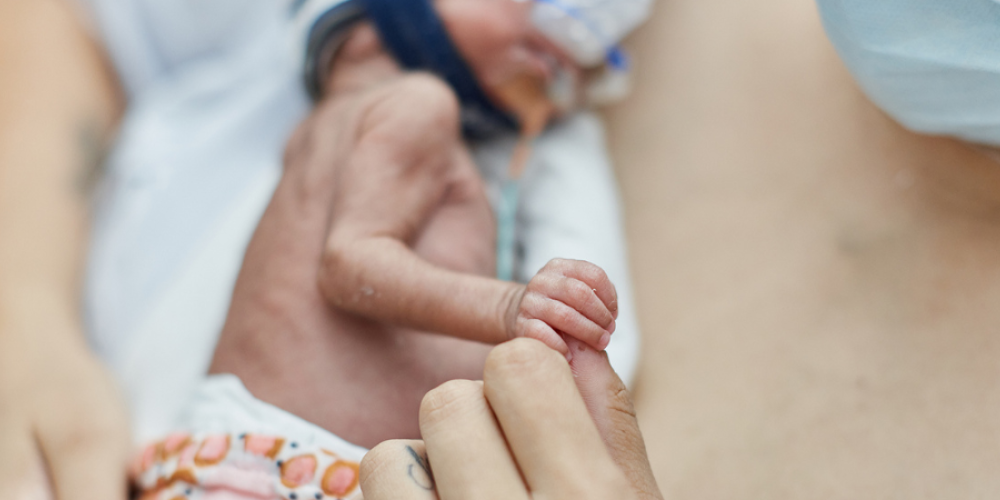
When A/Prof Louise Owen began her neonatal training, she considered research as “the boring side of medicine”. Then she noticed that different hospitals were supporting preterm babies to breathe in completely different ways, with little evidence showing which approach was best. The insight shifted her path and inspired her initial research questions.
Since then, she has built a substantial research career focused on improving how preterm babies are stabilised in their first moments of life. Her work has contributed to understanding the impact of different breathing techniques and equipment, helping replace inconsistent practices with evidence‑based care.
Louise now leads the AIROPLANE trial, involving more than 1,800 babies across Australia. The study is helping answer a long‑standing question in newborn care: how much oxygen preterm babies really need in the delivery room to give them the safest possible start.
“You don’t have to have it all figured out to become a researcher.”
What unites these women isn’t certainty; it’s curiosity.
Charlotte says, “Everything takes more time than you think but hard things are usually worthwhile.”
Robyn reflects that evidence doesn’t stand still: “Just because we did something five or ten years ago doesn’t mean it’s best practice now.”
Yasmin says the key is persistence: “You just keep trying – and you have people who believe in you.”
And Louise reminds us why the work matters: “We are just trying to make the babies better.”
Their stories show that research often begins with a practical question: how can we improve care? For many scientists, including these four, that question becomes the starting point for meaningful discovery.
Learn more about the Women's research here: Research | The Royal Women's Hospital
Read related content from the Women's
-
 The Women’s to co-lead global menopause study on women’s heart health
A million-dollar global research project co-led by Australia and the UK is taking a key step towards closing the gender gap in heart disease.
Learn more -
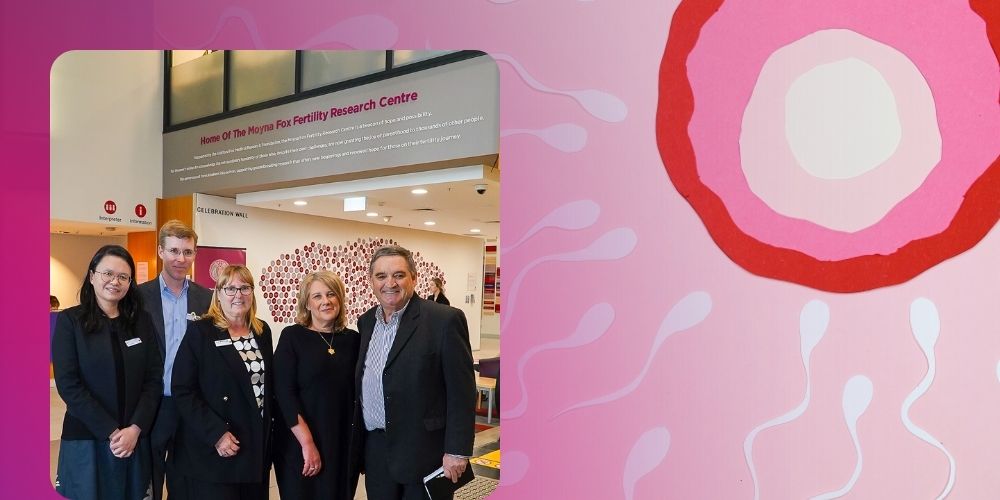 Sperm injection trial gives public IVF patients a bonus chance
A fertility trial at the Women’s is giving some IVF patients another chance at pregnancy if their eggs fail to fertilise. This outcome usually ends a cycle before it has begun.
Learn more -
 Is there a link between endometriosis and ectopic pregnancy? New study says: yes
New research from the Women’s shows that over half of women who had surgery for an ectopic pregnancy also had hidden endometriosis.
Learn more -
 Prem babies become capable adults when grown up, new study confirms
New data released from the Victorian Infant Collaborative Study (VICS) 1991-92 cohort reveals insights from the 25-year point of the long-term study.
Learn more